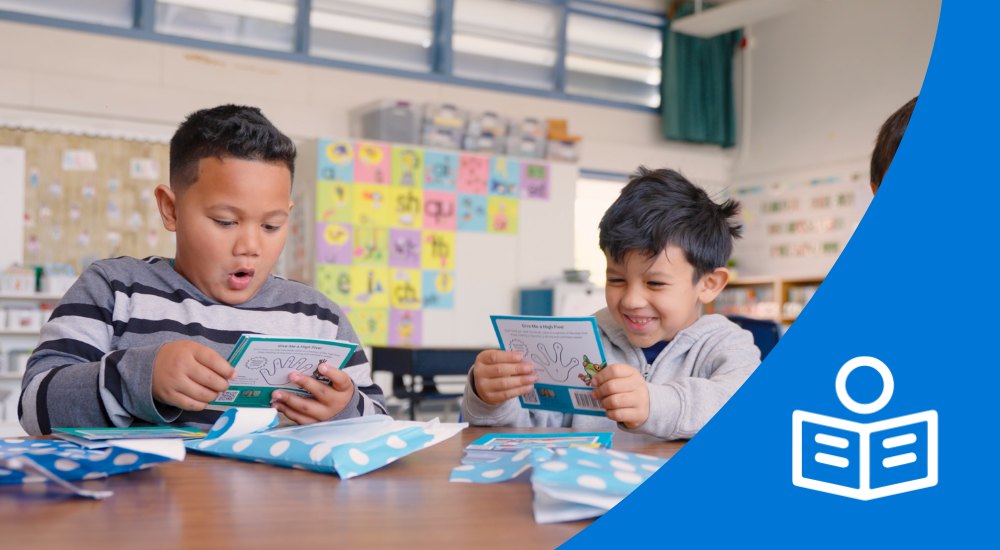

Children spend roughly 80% of their waking hours outside of the classroom, and what happens during that time influences their reading development. Research consistently links a strong home literacy environment to better reading outcomes (Dong et al., 2020; Sénéchal & LeFevre, 2002). This goes beyond how often a family reads with their child. Reading growth at home is shaped by both family engagement and access to materials that align with the child's developing skills (Inoue et al., 2020). Just Right Reader’s Take-Everywhere Literacy Packs™ are built around both, with evidence supporting an ESSA Level II rating for both Reading and Family Engagement (Jimenez et al., 2025).
Giving Readers the Right Materials
Research shows that data-driven individualization of the pacing and content of early reading instruction can produce stronger foundational reading outcomes than non-individualized instruction (Connor et al., 2011; 2013). BecauseTake-Everywhere™decodables are matched to each student's skill level based on their own assessment data, they are able to independently practice applying letter-sound knowledge and progress through the phases of word reading development, building toward faster, more automatic word recognition (Ehri, 2005; 2014; 2020).

When students using our decodables were compared to those using other decodables, they started lower and finished higher, achieving the equivalent of 3+ additional weeks of reading gains (Jimenez et al., 2025). Those who read outside the classroom at least three hours a week saw the largest gains, jumping from the 14th to the 72nd percentile on MAP Growth, far outpacing their peers (Schechter & Janakiefski, 2024).
Although decodables are designed to support meaningful independent practice, simultaneously building skills and confidence, students’ consistency and motivation to read outside of school is often driven by the family (Baker et al., 1997).
Giving Families the Tools to Help
Family literacy interventions, added alongside standard K-3 reading instruction, have been shown to meaningfully improve children's reading acquisition (Sénéchal & Young, 2008). While most families want to help their children become better readers, few know exactly what to do or how to do it. Family engagement research has found that participation increases when families are given specific, manageable activities to do at home (Epstein, 1995; York et al., 2019).

Each Take-Everywhere Literacy Pack™ is built around a routine families can follow without guessing what to do next. The inside front cover names the book's target phonics skill, gives example decodable words, and includes a QR code linking to a short (~ 2 minute) teacher-led video lesson for that skill, repeated again on the back cover for convenience. A caregiver watching with their student can learn what to reinforce during practice without needing training of their own. Each decodable ends with a writing activity, a comprehension question, and a list of its decodable and high-frequency words. Every title follows the same sequence, so the routine becomes as familiar to a family as the books themselves.
71% of caregivers whose students brought our decodables home used the QR-codes on the back, showing that most families, given an easy way to help, do take it (Jimenez et al., 2025). This is part of the reason ourTake-Everywhere Literacy Packs™ are so effective, helping students achieve 8x larger reading gains than those without them in just six weeks (Schechter & Janakiefski, 2024).
The Result
Just Right Reader’sTake-Everywhere Literacy Packs™ extend reading practice beyond the school day. With practice materials matched to each student’s skill level, and scaffolding that gives their families a clear, specific way to support them at home, reading gains go further.

References
Baker, L., Scher, D., & Mackler, K. (1997). Home and family influences on motivations for reading. Educational Psychologist, 32(2), 69–82.https://www.tandfonline.com/doi/abs/10.1207/s15326985ep3202_2
Connor, C. M., Morrison, F. J., Schatschneider, C., Toste, J. R., Lundblom, E., Crowe, E. C., & Fishman, B. (2011). Effective classroom instruction: Implications of child characteristics by reading instruction interactions on first graders’ word reading achievement. Journal of Research on Educational Effectiveness, 4(3), 173–207.https://pmc.ncbi.nlm.nih.gov/articles/PMC3251831/
Connor, C. M., Morrison, F. J., Fishman, B., Crowe, E. C., Al Otaiba, S., & Schatschneider, C. (2013). A longitudinal cluster-randomized controlled study on the accumulating effects of individualized literacy instruction on students’ reading from first through third grade. Psychological Science, 24(8), 1408–1419.https://pmc.ncbi.nlm.nih.gov/articles/PMC4737583/
Dong, Y., Wu, S. X.-Y., Dong, W.-Y., & Tang, Y. (2020). The effects of home literacy environment on children’s reading comprehension development: A meta-analysis. Educational Sciences: Theory & Practice, 20(2), 63–82.https://psycnet.apa.org/record/2020-61819-005
Ehri, L. C. (2005). Development of sight word reading: Phases and findings. In M. J. Snowling & C. Hulme (Eds.), The science of reading: A handbook (pp. 135–154). Blackwell Publishing.https://onlinelibrary.wiley.com/doi/10.1002/9780470757642.ch8
Ehri, L. C. (2014). Orthographic mapping in the acquisition of sight word reading, spelling memory, and vocabulary learning. Scientific Studies of Reading, 18(1), 5–21.https://www.tandfonline.com/doi/abs/10.1080/10888438.2013.819356
Ehri, L. C. (2020). The science of learning to read words: A case for systematic phonics instruction. Reading Research Quarterly, 55(S1), S45–S60.https://ila.onlinelibrary.wiley.com/doi/10.1002/rrq.334
Epstein, J. L. (1995). School/family/community partnerships: Caring for the children we share. Phi Delta Kappan, 76(9), 701–712.https://www.jstor.org/stable/20405436
Inoue, T., Manolitsis, G., de Jong, P. F., Landerl, K., Parrila, R., & Georgiou, G. K. (2020). Home literacy environment and early literacy development across languages varying in orthographic consistency. Frontiers in Psychology, 11, Article 1923.https://www.frontiersin.org/journals/psychology/articles/10.3389/fpsyg.2020.01923/full
Jimenez, S., Ilievski, I., Mason, M. L., & Schechter, R. L. (2025). Just Right Reader Take-Everywhere Literacy Packs efficacy study: Examining the impact on kindergarten students from MOY to EOY 2025. LXD Research.https://eric.ed.gov/?id=ED677147
Schechter, R., & Janakiefski, L. (2024). Just Right Reader: Pilot study in Texas, spring 2024. LXD Research.https://eric.ed.gov/?id=ED660766
Sénéchal, M., & LeFevre, J.-A. (2002). Parental involvement in the development of children’s reading skill: A five-year longitudinal study. Child Development, 73(2), 445–460.https://pubmed.ncbi.nlm.nih.gov/11949902/
Sénéchal, M., & Young, L. (2008). The effect of family literacy interventions on children’s acquisition of reading from kindergarten to grade 3: A meta-analytic review. Review of Educational Research, 78(4), 880–907.https://eric.ed.gov/?id=EJ896380
York, B. N., Loeb, S., & Doss, C. (2019). One step at a time: The effects of an early literacy text-messaging program for parents of preschoolers. Journal of Human Resources, 54(3), 537–566.https://jhr.uwpress.org/content/54/3/537