
Spanish–English bilingual students are the largest multilingual group in U.S. schools. Yet most early literacy research, and most decodable books, have been built around English-only instruction.
Strong English phonics instruction is critical. But bilingual students are learning to read in two languages, and they need practice that honors both.
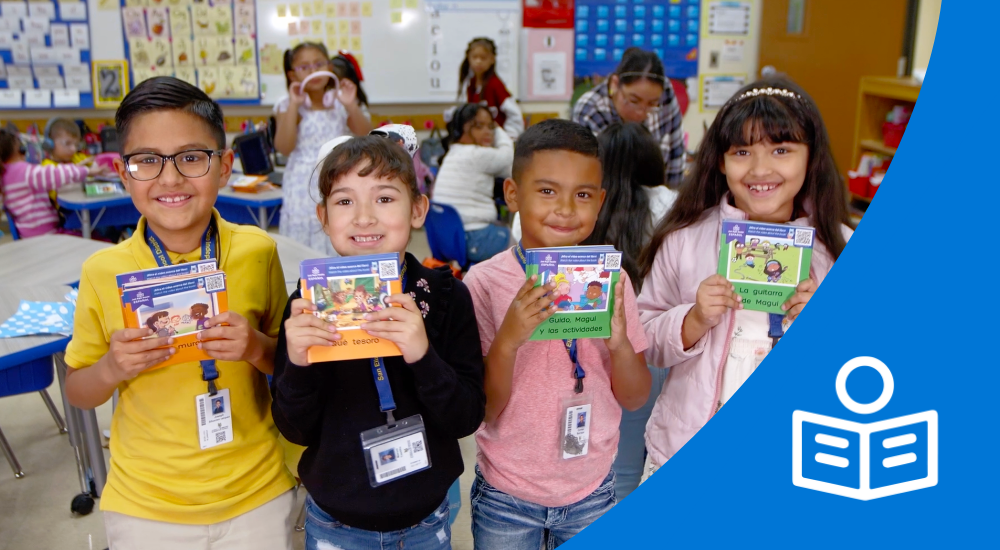
A new peer-reviewed study, "Inclusive Literacy Practices Using English and Spanish Decodable Texts for Multilingual Students," published in Education Sciences, followed Spanish–English bilingual kindergarten and second-grade students in a Texas dual language program as they used Just Right Reader Take-Everywhere Literacy Packs™. The findings point to a promising path for biliteracy: authentic Spanish decodables, paired with multilingual family supports, can strengthen reading at school, home, and everywhere.
- Second graders grew in Spanish reading. After adjusting for beginning-of-year DIBELS scores, second graders using Take-Everywhere Literacy Packs™ scored an estimated 13.48 RIT points higher on Spanish MAP Growth than comparison students, a statistically significant difference.
- Vocabulary and listening comprehension trended upward in both languages. More treatment students met or exceeded expectations on MAP Fluency, Picture Vocabulary, and Listening Comprehension across English and Spanish.
- DIBELS growth favored treatment students. Kindergarten and second-grade treatment students showed slightly greater middle-of-year-to-end-of-year DIBELS growth, with small-to-moderate positive effect sizes.
- Authentic Spanish decodables matter. Educators valued books written by bilingual educators and aligned with a Spanish-specific phonics progression, rather than translated English resources.
- Families felt more confident helping at home. Caregivers described the books and QR-code video lessons as clear, easy to use, and accessible in their preferred language.
Inside the study
Researchers from San Diego State University and LXD Research used a mixed-methods, matched quasi-experimental design during the 2024–2025 school year. The study took place in a diverse central Texas district serving more than 10,000 students.
The sample included 164 kindergarteners (73 treatment, 91 comparison) and 146 second graders (73 treatment, 73 comparison) across two treatment schools and two comparison schools.
Students in treatment schools received:
- Personalized decodables matched to each student's phonics proficiency, based on district reading assessments
- English decodables and authentic Spanish decodables written by bilingual educators and aligned to a Spanish-specific phonics progression
- Multilingual family supports, including QR-linked, teacher-led video phonics lessons in 14+ languages.
Comparison students used other Science of Reading–aligned decodables, but without the same combination of personalized text matching, Spanish-language decodables, and multilingual family supports. Researchers measured outcomes with mClass DIBELS, NWEA MAP Fluency, and NWEA MAP Growth, and gathered surveys and interviews from families, teachers, and literacy coaches.

Why authentic Spanish decodables matter
Spanish is not English in translation. It has its own phonics progression, its own letter patterns, and highly consistent sound-spelling relationships.
Research on cross-linguistic transfer shows that phonological awareness, vocabulary, and decoding skills built in Spanish can support English reading. When students practice decoding in a transparent language like Spanish, early success builds skills and confidence that carry over to other languages.
Instructional coaches in the study made this point directly. They noted that decoding skills in English and Spanish are not directly transferable and stressed the importance of native speakers developing literacy materials that are linguistically authentic and culturally relevant.
That is exactly how our Spanish decodables are built: written by bilingual educators, aligned to a Spanish-specific phonics progression, and designed so students see themselves and their communities in every story.

What the research shows
The clearest result came from second-grade Spanish reading. After accounting for beginning-of-year DIBELS Composite Scores, treatment students outscored their comparison peers on end-of-year Spanish MAP Growth.
Estimated end-of-year advantage for second graders using Take-Everywhere Literacy Packs™, after adjusting for beginning-of-year DIBELS scores (p = 0.043, partial η² = 0.235).
The authors describe this as a promising preliminary finding, based on a small analytic sample of 16 students, that warrants replication with a larger group.
Across both grades, MAP Fluency results showed encouraging patterns in language comprehension:
- Picture Vocabulary: A larger share of treatment kindergarteners performed above grade-level expectations, and a smaller share of treatment second graders scored below expectations.
- Listening Comprehension: A considerably higher percentage of treatment students in both kindergarten and second grade met expectations than their peers.
- DIBELS growth: Treatment students in both grades showed slightly greater mean growth from middle to end of year, with positive effect sizes of 0.28 in kindergarten and 0.32 in second grade.
These MAP Fluency and DIBELS patterns were not statistically significant. Still, the authors note that vocabulary and listening comprehension often grow before changes appear on broader reading measures, making them early signals worth watching.
Families as partners in biliteracy

Families want to help. But wanting to help and knowing how to help are two different things, especially when a family's home language differs from the language of instruction.
Every Just Right Reader decodable includes a QR code linking to a short, teacher-led video phonics lesson, available in 14+ languages. Participants identified these video lessons as especially valuable because families and children could engage with phonics instruction together in English and Spanish.
"Before receiving the books, I wasn't sure how to help him or what to do to have him practice reading. The books helped me feel more confident and willing to support my child's reading."
Parent, study participantFamilies reported using the packs at home about three days per week for 11–15 minutes per session. At school, most students used them for four to five days per week for 11–20 minutes a day, mainly during small-group instruction.
What teachers and families noticed
Teachers and families saw growing confidence, independence, and enjoyment of reading. Students became more willing to read on their own, both at home and at school.
Caregivers described concrete milestones. One family shared that their child moved from reading isolated sight words to reading full sentences. Another noticed their child asking more questions about pronunciation and about the images associated with new letters and words.
"At the beginning of the year, he struggled and was behind on reading. I can honestly say that with the help of his awesome teacher and the Just Right Reader books, he has improved so much. He is more confident and enjoys reading the books."
Parent of a multilingual kindergartenerDual-language teachers described the decodables as easy to use and highly engaging, with visual supports that helped students connect pictures and words.
"They were so easy to use, simple… I get so many books read, and they like the books. They like the stories. So every time that I have a chance that's like WIN [What I Need] time, I just pass them out."
Dual-language teacherWhat effective biliteracy support looks like
The study highlights a few areas that every dual language program can build on.
Decodables are matched to each student's phonics level
Treatment students received personalized collections of decodables based on district reading assessments. Practice lands best when it meets students exactly where they are.
Spanish decodables are authentic, not translated
Educators valued books that reflected Spanish-specific letter patterns and phonics progressions. Materials written by bilingual educators respect how each language actually works.
Practice extends into the home, in every family's language
QR-linked video lessons helped caregivers support phonics practice regardless of their preferred language. Clear guidance turns good intentions into real reading time.
Implementation starts early and stays manageable
Because the packs arrived in late fall, the analysis focused on the spring semester. Educators noted that earlier implementation, added professional development, and fewer books per pack would make small-group management easier.
Comparison classrooms
Students read a mix of Science of Reading–aligned decodables from several publishers. Materials were not consistently personalized, did not include the same Spanish-language decodables, and did not offer multilingual video supports for families.
Take-Everywhere Literacy Packs™ classrooms
Students read personalized English and authentic Spanish decodables matched to their phonics level. Each book included a QR-linked video phonics lesson in 14+ languages so that families could reinforce classroom skills at home.
Reading the results with care
These results are promising early evidence, not a final verdict. The authors are clear that small samples, a shorter spring-semester implementation, and baseline differences in kindergarten limit how far the findings can be generalized.
What stands out is the convergence: positive trends in Spanish vocabulary and comprehension, paired with consistent reports of confidence, engagement, and family involvement. The authors call for larger, full-year studies to confirm the effects, and we welcome that work.
How Just Right Reader supports dual language programs
Just Right Reader offers the largest library of Science of Reading decodables, available in English and Spanish. These decodables are:
- Available in authentic Spanish, with Spanish decodables aligned to a Spanish-specific phonics progression
- Supported by teacher-led video lessons in 14+ languages, so every family knows exactly what to do
- Aligned to your scope and sequence, so practice at home reinforces what's happening in the classroom'


ESSA Level 2 Research 71 points
In an independent LXD Research study that met ESSA Level 2 – Moderate Evidence criteria, students using Take-Everywhere Literacy Packs™ averaged a 71-point gain on DIBELS Composite Scores, compared with 61 points for peers using competitor decodables.
Frequently asked questions
What is the Just Right Reader biliteracy study?
It is a peer-reviewed study published in Education Sciences in 2026 titled "Inclusive Literacy Practices Using English and Spanish Decodable Texts for Multilingual Students." It examined how Just Right Reader Take-Everywhere Literacy Packs™ supported Spanish–English bilingual kindergarten and second-grade students in a Texas dual language program during 2024–2025.
Do Spanish decodables help bilingual students learn to read?
Evidence suggests they can. In this study, second graders using English and Spanish decodables from Just Right Reader scored an estimated 13.48 RIT points higher on Spanish MAP Growth than comparison students after adjusting for baseline scores. Research on cross-linguistic transfer also shows that skills built in Spanish can support English reading.
What is the difference between authentic and translated Spanish decodables?
Authentic Spanish decodables are written for Spanish and follow a Spanish-specific phonics progression, while translated decodables convert English books into Spanish. Educators in the study stressed that English and Spanish decoding skills are not directly transferable, so materials should reflect Spanish letter patterns and be developed by native speakers.
How do Take-Everywhere Literacy Packs™ support multilingual families?
Each decodable includes a QR code linking to a short, teacher-led video phonics lesson available in 14+ languages. Families in the study said the books and videos made it easier to practice reading at home and increased their confidence in supporting their child, in English or Spanish.
How often did students use the Take-Everywhere Literacy Packs?
Teachers reported that most students used the packs four to five days per week for 11–20 minutes a day at school, mainly in small groups. Families reported home use of about 3 days per week, with 11–15 minutes per session.
Were the results statistically significant?
The second-grade Spanish MAP Growth difference was statistically significant (p = 0.043) in a small sample of 16 students. Patterns in MAP Fluency vocabulary, listening comprehension, and DIBELS growth favored treatment students but were not statistically significant, and the authors recommend larger studies to confirm the effects.
Who conducted the study?
The study was led by Krystina Raymond of San Diego State University's College of Education, with Sofia Jimenez, Madison Lee Mason, and Rachel Schechter of LXD Research. It was funded by Just Right Reader, as disclosed in the published article.
Inclusive Literacy Practices Using English and Spanish Decodable Texts for Multilingual Students
Dig into the full methods, data, and findings in the peer-reviewed article published in Education Sciences.
Read the full studyIf your district is ready to bring authentic English and Spanish decodables to your dual language classrooms, we've got you covered. Explore our Spanish classroom libraries and learn how Take-Everywhere Literacy Packs™ extend reading practice to every home.