
Home book-delivery programs play a valuable role in expanding children’s access to books and encouraging reading at home. While research shows these programs are beneficial, their strongest effects are on the home literacy environment and children’s interest in reading, with smaller effects on literacy skills (de Bondt et al., 2020).
Just Right Reader’s Take-Everywhere Literacy Packs™ are designed to build on the benefits of access to books with targeted, skill-building practice grounded in the Science of Reading. Evidence shows they produce stronger reading outcomes, even when compared against students who already had access to other decodable books (Jimenez et al., 2025). Johns Hopkins’ Evidence for ESSA has recognized Take-Everywhere Literacy Packs™ for improving both reading achievement and family engagement (Evidence for ESSA, n.d.-a;n.d.-b).
How do Take-Everywhere Literacy Packs™ go beyond book delivery?
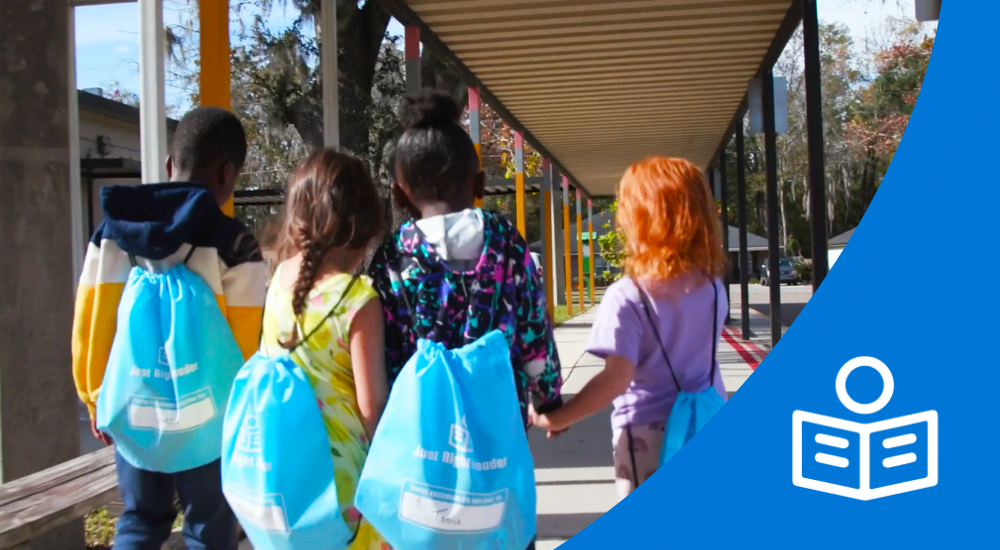
Each Take-Everywhere Literacy Pack™ packages books in a small, personalized drawstring backpack designed to travel between school and home. The learning travels with it. Teachers can introduce the books, skills, and routines during the school day using pre-made small groups, lesson plans, and professional development provided by Just Right Reader, so students arrive home already familiar with how to use their materials. At home, families can continue the same routine with clear directions and QR-linked video lessons built into every book.
Each set of books is personalized using assessment data or teacher placement, aligning with evidence that reading outcomes are stronger when practice is matched to students’ current skills (Connor et al., 2013).

Materials are drawn from several libraries built to address every need:
Pre-Emergent, kindergarten, first- and second-grade libraries are highly decodable and follow a Science-of-Reading-based phonics progression, giving developing readers repeated opportunities to apply taught sound-spelling patterns in connected text, a research-backed approach to building foundational reading skills (Cheatham & Allor, 2012;Foorman et al., 2016).
High-Interest Chapter Books for upper-elementary and middle-school readers develop morphology and text-structure skills, focusing practice in areas shown to improve reading comprehension (Hebert et al., 2016;Zhang et al., 2023).
Success Series Chapter Books for upper-elementary, middle-, and high-school English learners offer phonics-based reading practice with vocabulary scaffolds, such as Spanish cognates and visual aids, building skills shown to improve their English word reading abilities (Murphy Odo, 2021).
Districts can also add Science of Reading Games for extended, game-based foundational-skills practice, which research has linked to stronger early reading outcomes (Ronimus et al., 2019;Vanbecelaere et al., 2020).

References
Cheatham, J. P., & Allor, J. H. (2012). The influence of decodability in early reading text on reading achievement: A review of the evidence.Reading and Writing, 25, 2223–2246.https://doi.org/10.1007/s11145-011-9355-2
Connor, C. M., Morrison, F. J., Fishman, B., Crowe, E. C., Al Otaiba, S., & Schatschneider, C. (2013). A longitudinal cluster-randomized controlled study on the accumulating effects of individualized literacy instruction on students’ reading from first through third grade.Psychological Science, 24(8), 1408–1419.https://doi.org/10.1177/0956797612472204
de Bondt, M., Willenberg, I. A., & Bus, A. G. (2020). Do book giveaway programs promote the home literacy environment and children’s literacy-related behavior and skills? Review of Educational Research, 90(3), 349–375.https://doi.org/10.3102/0034654320922140
Evidence for ESSA. (n.d.-a). Just Right Reader Take-Everywhere Literacy Packs™ – Family engagement.https://www.evidenceforessa.org/program/just-right-reader-take-everywhere-literacy-packs-family-engagement/
Evidence for ESSA. (n.d.-b). Just Right Reader Take-Everywhere Literacy Packs™ – Reading.https://www.evidenceforessa.org/program/just-right-reader-take-everywhere-literacy-packs/
Foorman, B., Beyler, N., Borradaile, K., Coyne, M., Denton, C. A., Dimino, J., Furgeson, J., Hayes, L., Henke, J., Justice, L., Keating, B., Lewis, W., Sattar, S., Streke, A., Wagner, R., & Wissel, S. (2016).Foundational skills to support reading for understanding in kindergarten through 3rd grade (NCEE 2016-4008). National Center for Education Evaluation and Regional Assistance, Institute of Education Sciences, U.S. Department of Education. https://ies.ed.gov/ncee/wwc/Docs/practiceGuide/wwc_foundationalreading_040717.pdf
Hebert, M., Bohaty, J. J., Nelson, J. R., & Brown, J. (2016). The effects of text structure instruction on expository reading comprehension: A meta-analysis.Journal of Educational Psychology, 108(5), 609–629.https://experts.umn.edu/en/publications/the-effects-of-text-structure-instruction-on-expository-reading-c/
Jimenez, S., Ilievski, I., Mason, M. L., & Schechter, R. L. (2025).Just Right Reader Take-Everywhere Literacy Packs efficacy study, Examining the impact on kindergarten students from MOY to EOY 2025. LXD Research.https://eric.ed.gov/?id=ED677147
Murphy Odo, D. (2021). A meta-analysis of the effect of phonological awareness and/or phonics instruction on word and pseudo-word reading of English as an L2.SAGE Open, 11(4).https://doi.org/10.1177/21582440211059168
Ronimus, M., Eklund, K., Pesu, L., & Lyytinen, H. (2019). Supporting struggling readers with digital game-based learning.Educational Technology Research and Development, 67, 639–663.https://doi.org/10.1007/s11423-019-09658-3
Vanbecelaere, S., Van den Berghe, K., Cornillie, F., Sasanguie, D., Reynvoet, B., & Depaepe, F. (2020). The effects of two digital educational games on cognitive and non-cognitive math and reading outcomes.Computers & Education, 143, 103680.https://doi.org/10.1016/j.compedu.2019.103680
Zhang, D., Ke, S., & Mo, Y. (2023). Morphology in reading comprehension among school-aged readers of English: A synthesis and meta-analytic structural equation modeling study.Journal of Educational Psychology, 115(5), 683–699.https://doi.org/10.1037/edu0000797