
What is a Read-at-Home plan?
A read-at-home plan is a set of instructions and practice materials that a school provides to a student's family to support the student's reading skills with additional practice beyond the classroom. As of September 2026, thirty-five states and the District of Columbia have enacted legislation requiring read-at-home plans for students struggling with reading (ExcelinEd, 2026;New Mexico Senate Bill 37, 2026). In most of these states, a school’s obligation to provide an individualized read-at-home plan is triggered by routine literacy screenings that identify students experiencing reading difficulties (ExcelinEd, 2026).
Read-at-home plans leverage the time students spend outside the classroom to extend their reading practice. Research on the home literacy environment has found that children with regular access to books and reading practice at home develop stronger reading comprehension over time (Dong et al., 2020;Sénéchal & LeFevre, 2002). Further, family-implemented literacy interventions are a proven way to meaningfully improve reading outcomes across the elementary grades (Dahl-Leonard et al., 2025;Sénéchal & Young, 2008).
How does Just Right Reader support strong Read-At-Home plans?
From individualized practice materials to statute-compliant family activity guide templates, Just Right Reader is a one-stop shop for read-at-home plan requirements.
Science of Reading Take-Everywhere Literacy Packs™ provide the practice materials that read-at-home plans require, extending students’ learning beyond the school day with science-of-reading-based decodables, chapter books, and games. Take-Everywhere Literacy Packs™ are backed by ESSA Level II research for both Reading and Family Engagement (Jimenez et al., 2025), demonstrating the strength of their unique combination of features, described below.

Decodables grounded in the science of reading. Just Right Reader's decodable books span Pre-Emergent through second-grade libraries, covering everything from early letter-sound recognition to decoding multisyllabic words. Each title is 90% decodable, allowing students to practice and build confidence with phonics skills in connected text (Anderson et al., 1985;Juel, 1994). At the same time, 20% of each page targets the new skill introduced in that title.
Support for older readers and language learners. Our High-Interest Chapter Books develop morphology and text-structure skills in upper-elementary and middle-school readers, focusing practice in areas shown to improve reading comprehension at these levels (Hebert et al., 2016;Zhang et al., 2023). For upper-elementary, middle- and high-school English learners, our Language Acquisition Chapter Books offer phonics-based reading practice with vocabulary scaffolds, like Spanish cognates and visual aids, building skills that improve word reading (Murphy Odo, 2021).
Optional extended practice with games. Our new Science of Reading Games can be packaged alongside decodables for game-based practice targeting foundational reading skills, which is shown to strengthen early reading outcomes (Ronimus et al., 2019;Vanbecelaere et al., 2020). Our game books are the first to pair decodables with 100% science-of-reading-based activities. Each one reinforces the skill in its parallel decodable and includes its own QR-code video lesson.
Data-driven personalization. Each decodable book included in Take-Everywhere Literacy Packs™ is selected based on students' assessment data, so each student's practice is aligned with their individual needs. Individualizing pacing and content to a student's actual skill level, rather than a single grade-level standard, produces stronger reading gains than uniform instruction (Connor et al., 2011,2013).
Delivered regularly, ready to use anywhere. Each student receives Take-Everywhere Literacy Packs™ at regular intervals throughout the school year in a small customized backpack, sized to travel between school and home.
Paired with teacher supports. Access to pre-made small groups, easy-to-follow lesson plans, and professional development makes targeted instruction easier to plan, deliver, and sustain. Pairing student materials with these additional supports for teachers produces stronger learning gains than less comprehensive approaches (Piper et al., 2018). After building familiarity with skills and routines in class, teachers can send students home prepared to practice confidently and well.
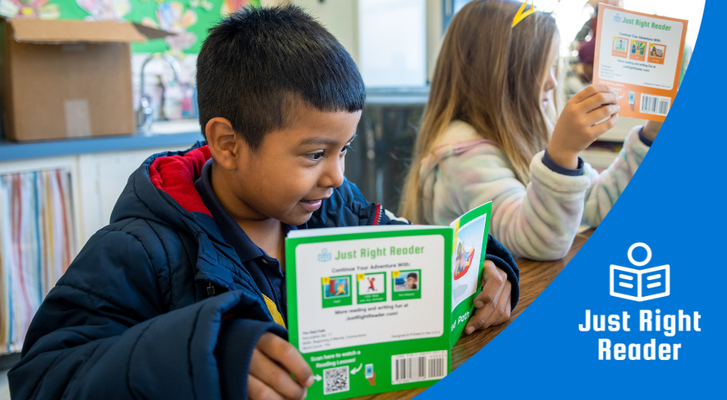
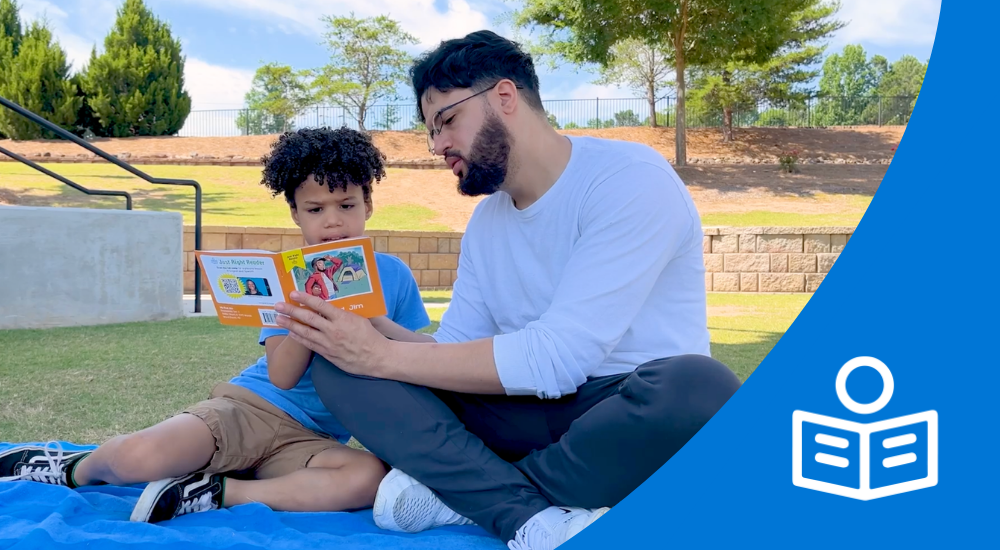
Built for families to follow. Every book follows the same structure, supporting a regular home reading routine. On the back of each book, a QR code links to a short teacher-led video that a caregiver can watch alongside their student before practicing together. Family engagement research shows participation rises when families are given a specific, repeatable activity like this, rather than general encouragement to read more (Epstein, 1995;York et al., 2019).
Accessible to multilingual families. The QR-linked video lessons on each book are available in up to 14 languages, and books are available in English and Spanish. Research has found increased reading confidence and family involvement, with measurable gains in Spanish reading growth, among bilingual students using our Take-Everywhere Literacy Packs™ (Raymond et al., 2026).

For states purchasing Take-Everywhere Literacy Packs™ to support read-at-home plans, Just Right Reader can adapt our family activity guide templates to meet local statutory requirements.
Ready to bring a customized read-at-home plan to your district or school? Learn more here.

References
Anderson, R. C., Hiebert, E. H., Scott, J. A., & Wilkinson, I. A. G. (1985).Becoming a nation of readers: The report of the Commission on Reading. National Academy of Education.https://naeducation.org/publication/becoming-a-nation-of-readers-the-report-of-the-commission-on-reading/
Connor, C. M., Morrison, F. J., Schatschneider, C., Toste, J. R., Lundblom, E., Crowe, E. C., & Fishman, B. (2011). Effective classroom instruction, Implications of child characteristics by reading instruction interactions on first graders' word reading achievement.Journal of Research on Educational Effectiveness, 4(3), 173–207.https://doi.org/10.1080/19345747.2010.510179
Connor, C. M., Morrison, F. J., Fishman, B., Crowe, E. C., Al Otaiba, S., & Schatschneider, C. (2013). A longitudinal cluster-randomized controlled study on the accumulating effects of individualized literacy instruction on students' reading from first through third grade.Psychological Science, 24(8), 1408–1419.https://doi.org/10.1177/0956797612472204
Dahl-Leonard, K., Hall, C., Cho, E., Capin, P., Roberts, G. J., Kehoe, K. F., Haring, C., Peacott, D., & Demchak, A. (2025). Examining the effects of family-implemented literacy interventions for school-aged children: A meta-analysis.Educational Psychology Review, 37, Article 10.https://doi.org/10.1007/s10648-025-09985-3
Dong, Y., Wu, S. X.-Y., Dong, W.-Y., & Tang, Y. (2020). The effects of home literacy environment on children's reading comprehension development: A meta-analysis.Educational Sciences, Theory & Practice, 20(2), 63–82.https://doi.org/10.12738/jestp.2020.2.005
Epstein, J. L. (1995). School/family/community partnerships, Caring for the children we share.Phi Delta Kappan, 76(9), 701–712.https://www.jstor.org/stable/20405436
ExcelinEd. (2026).Comprehensive early literacy policy: A state-by-state analysis of fundamental principles.https://excelined.org/policy-playbook/early-literacy/
Hebert, M., Bohaty, J. J., Nelson, J. R., & Brown, J. (2016). The effects of text structure instruction on expository reading comprehension: A meta-analysis.Journal of Educational Psychology, 108(5), 609–629.https://experts.umn.edu/en/publications/the-effects-of-text-structure-instruction-on-expository-reading-c/
Jimenez, S., Ilievski, I., Mason, M. L., & Schechter, R. L. (2025).Just Right Reader Take-Everywhere Literacy Packs efficacy study, Examining the impact on kindergarten students from MOY to EOY 2025. LXD Research.https://eric.ed.gov/?id=ED677147
Juel, C. (1994).Learning to read and write in one elementary school. Springer.https://doi.org/10.1007/978-1-4612-4282-6
Murphy Odo, D. (2021). A meta-analysis of the effect of phonological awareness and/or phonics instruction on word and pseudo-word reading of English as an L2.SAGE Open, 11(4).https://doi.org/10.1177/21582440211059168
New Mexico Senate Bill 37, High-Quality Literacy Instruction Act, 57th Legislature, 2nd Session. (2026).https://www.nmlegis.gov/Sessions/26%20Regular/bills/senate/SB0037.HTML
Piper, B., Simmons Zuilkowski, S., Dubeck, M., Jepkemei, E., & King, S. J. (2018). Identifying the essential ingredients to literacy and numeracy improvement: Teacher professional development and coaching, student textbooks, and structured teachers’ guides. World Development, 106, 324–336.https://doi.org/10.1016/j.worlddev.2018.01.018
Raymond, K., Jimenez, S., Mason, M. L., & Schechter, R. (2026). Inclusive literacy practices using English and Spanish decodable texts for multilingual students.Education Sciences, 16(9), 1493.https://doi.org/10.3390/educsci16091493
Ronimus, M., Eklund, K., Pesu, L., & Lyytinen, H. (2019). Supporting struggling readers with digital game-based learning.Educational Technology Research and Development, 67, 639–663.https://doi.org/10.1007/s11423-019-09658-3
Sénéchal, M., & LeFevre, J.-A. (2002). Parental involvement in the development of children's reading skill: A five-year longitudinal study.Child Development, 73(2), 445–460.https://doi.org/10.1111/1467-8624.00417
Sénéchal, M., & Young, L. (2008). The effect of family literacy interventions on children's acquisition of reading from kindergarten to grade 3: A meta-analytic review.Review of Educational Research, 78(4), 880–907.https://doi.org/10.3102/0034654308320319
Vanbecelaere, S., Van den Berghe, K., Cornillie, F., Sasanguie, D., Reynvoet, B., & Depaepe, F. (2020). The effects of two digital educational games on cognitive and non-cognitive math and reading outcomes.Computers & Education, 143, 103680.https://doi.org/10.1016/j.compedu.2019.103680
York, B. N., Loeb, S., & Doss, C. (2019). One step at a time: The effects of an early literacy text-messaging program for parents of preschoolers.Journal of Human Resources, 54(3), 537–566.https://jhr.uwpress.org/content/54/3/537
Zhang, D., Ke, S., & Mo, Y. (2023). Morphology in reading comprehension among school-aged readers of English: A synthesis and meta-analytic structural equation modeling study.Journal of Educational Psychology, 115(5), 683–699.https://doi.org/10.1037/edu0000797